
Cyber Strategy, Architecture & GRC

This category explores the strategic layer of cyber security — where long‑term vision, technical architecture, and governance intersect. It covers how organisations design secure systems, build resilient architectures, align security with business goals, and navigate frameworks, risk, compliance, and regulatory expectations. From high‑level strategy to practical implementation, these articles break down the thinking, structures, and decision‑making that shape modern security programs.

A cybersecurity team sits around a conference table while a facilitator leads a tabletop exercise. The screen behind them displays the Tayven Cyber Security logo and the words “Tabletop Exercise: Cyber Security Team.”

How to Run a Cybersecurity Tabletop Exercise: A Complete Example Scenario and Facilitation Guide

Whenever I run a tabletop exercise, the first thing I do is set the tone for the room. I tell everyone that this is not a test and it’s not about catching anyone out. It’s a safe space to walk through our policies, procedures, and decision‑making as a team. The goal is to explore how we work, not judge how anyone performs.

How to Run a Cybersecurity Tabletop Exercise: A Complete Example Scenario and Facilitation Guide Read More »

A cybersecurity team sits around a conference table while a facilitator leads a tabletop exercise. The screen behind them displays the Tayven Cyber Security logo and the words “Tabletop Exercise: Cyber Security Team.”

How to Run a Cybersecurity Tabletop Exercise: Facilitator Script with Discussion Prompts

A good tabletop lives or dies on facilitation. A script doesn’t remove spontaneity, it creates psychological safety. It gives the facilitator a structure to fall back on, keeps the room aligned, and ensures the exercise stays focused on process rather than personalities. This script is written so that even a first‑time facilitator can run the scenario confidently while still leaving space for natural discussion and team dynamics.

How to Run a Cybersecurity Tabletop Exercise: Facilitator Script with Discussion Prompts Read More »

A cybersecurity team sits around a conference table while a facilitator leads a tabletop exercise. The screen behind them displays the Tayven Cyber Security logo and the words “Tabletop Exercise: Cyber Security Team.”

How to Write an After Action Report (AAR) for Cyber Tabletop Exercises

An After‑Action Report is where a tabletop exercise turns into something real. It’s the moment where the conversation becomes clarity, and clarity becomes improvement. This AAR captures not just what happened in the scenario, but how the team thought, reacted, hesitated, and learned, because that’s where the real value sits.

How to Write an After Action Report (AAR) for Cyber Tabletop Exercises Read More »

A cybersecurity team sits around a conference table while a facilitator leads a tabletop exercise. The screen behind them displays the Tayven Cyber Security logo and the words “Tabletop Exercise: Cyber Security Team.”

How to Create a Participant Handout for a Cybersecurity Tabletop Exercise

A participant handout sets the tone for the entire exercise. It gives everyone the same starting point, removes uncertainty, and helps people focus on the scenario rather than trying to remember process details. This one is designed to be read in under two minutes, just enough to orient the room without overwhelming it.

How to Create a Participant Handout for a Cybersecurity Tabletop Exercise Read More »

A printed Post‑Incident Review document with the Tayven Cyber Security logo resting on a laptop keyboard, showing a blue digital network map on the screen and a silver pen placed diagonally across the page.

How to Write a Post-Incident Review (PIR) Report (With Real-World Example)

A PIR isn’t just paperwork. It’s where the real learning happens. It’s the document that turns an incident into improvement. To show you what a mature, well‑structured PIR looks like in practice, here’s a full example based on a realistic MFA fatigue and OAuth compromise scenario.

How to Write a Post-Incident Review (PIR) Report (With Real-World Example) Read More »

Minimalist blue‑toned banner showing cybersecurity icons, a laptop with a shield, and the title “How to Write a Modern Incident Response Plan (IRP) Using NIST CSF 2.0.”

How to Write a Modern Incident Response Plan (IRP) Using NIST CSF 2.0

Most organisations have an IRP. Most discover it doesn’t work the moment they actually need it. Not because the document is wrong, but because it was written for the organisation they used to be, not the one responding to an incident today. Incidents in 2026 are cloud‑distributed, identity‑driven, SaaS‑entangled, and business‑impacting. Modern incident response is

How to Write a Modern Incident Response Plan (IRP) Using NIST CSF 2.0 Read More »

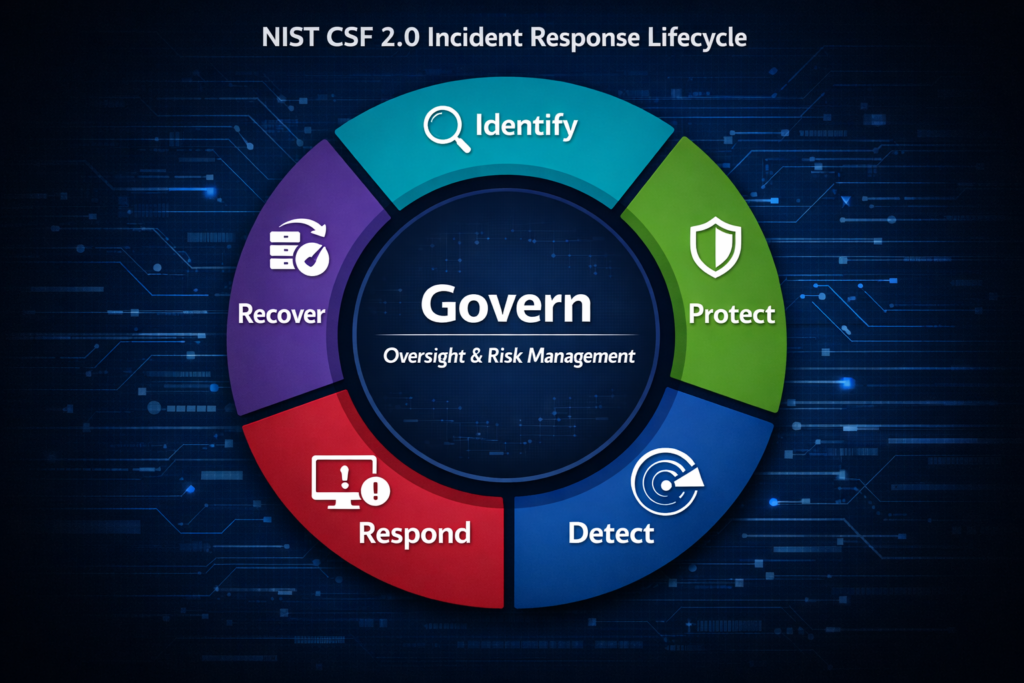
Circular NIST CSF 2.0 diagram with a dark‑navy “Govern” center and five equal outer segments labeled Identify, Protect, Detect, Respond, and Recover, each with its own color and icon on a cyber‑themed background.

The Evolution of Incident Response: Updating the Classic NIST IRP to the 2026 Framework

For years, cybersecurity teams followed the traditional NIST Incident Response Process: Preparation, Identification, Containment, Eradication, Recovery, and Lessons Learned. This model shaped how organisations built response capabilities and how students learned incident handling. The threat landscape has shifted dramatically, with cloud‑identity attacks defying linear phases, ransomware spreading before containment can begin, and supply‑chain compromises blurring

The Evolution of Incident Response: Updating the Classic NIST IRP to the 2026 Framework Read More »

Essential 8 Explained title graphic showing blue text and eight minimalist security icons representing each control.

The Essential 8 Explained Like You’re New to Cyber (But Want to Actually Understand It)

If you work in Australia, you’ve probably heard someone mention the ACSC Essential 8 in a meeting, usually right before everyone nods like they understand what’s going on. Spoiler: most people don’t. The Essential 8 is Australia’s baseline cyber security framework, a minimum and a voluntary baseline standard organisations can adopt to meet their cyber

The Essential 8 Explained Like You’re New to Cyber (But Want to Actually Understand It) Read More »