
governance

A printed document titled “NIST CSF 2.0 Explained: Functions, Categories & Outcomes (Complete Mapping Guide)” lies on a modern corporate desk beside a MacBook Pro. The Tayven Cyber Security logo is stamped on the top page, and the document is neatly stapled in the top‑left corner, ready to be read.

The Complete Guide to NIST CSF 2.0 Mappings: Functions, Categories & Outcomes (And How to Use Them)

Series Introduction Every IRP, PIR, playbook, and tabletop in this series maps back to NIST CSF 2.0. If you want your security work to look mature, consistent, and defensible, you can’t just say “we follow NIST CSF 2.0.” You need to understand how Functions, Categories, and Outcomes actually fit together and how to use those […]
The Complete Guide to NIST CSF 2.0 Mappings: Functions, Categories & Outcomes (And How to Use Them) Read More »

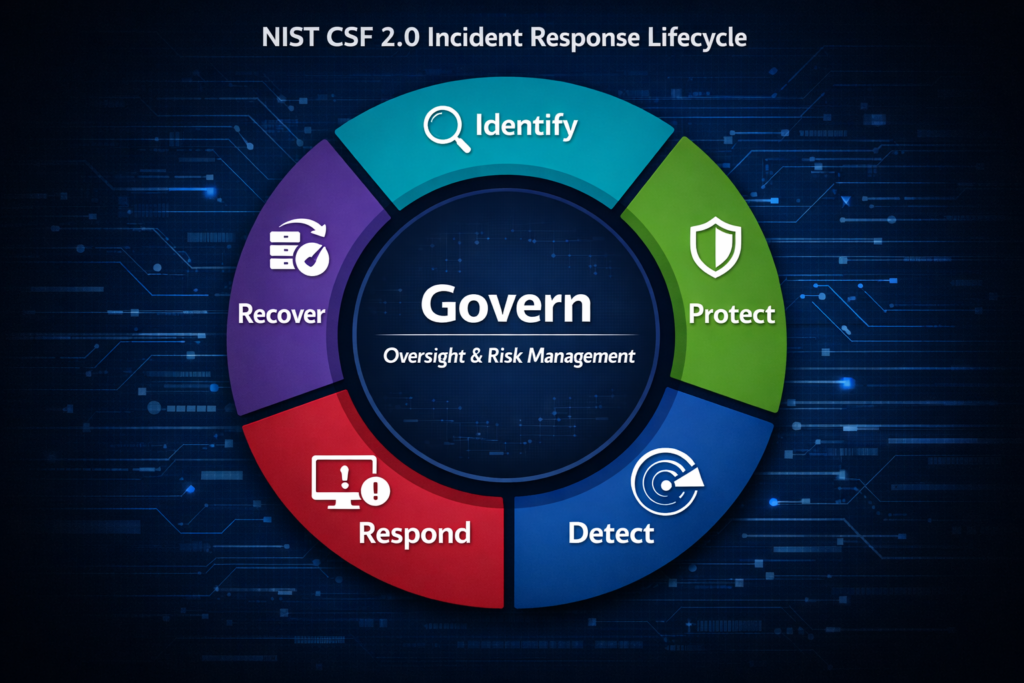
Circular NIST CSF 2.0 diagram with a dark‑navy “Govern” center and five equal outer segments labeled Identify, Protect, Detect, Respond, and Recover, each with its own color and icon on a cyber‑themed background.

The Evolution of Incident Response: Updating the Classic NIST IRP to the 2026 Framework

For years, cybersecurity teams followed the traditional NIST Incident Response Process: Preparation, Identification, Containment, Eradication, Recovery, and Lessons Learned. This model shaped how organisations built response capabilities and how students learned incident handling. The threat landscape has shifted dramatically, with cloud‑identity attacks defying linear phases, ransomware spreading before containment can begin, and supply‑chain compromises blurring

The Evolution of Incident Response: Updating the Classic NIST IRP to the 2026 Framework Read More »