
cybersecurity framework

A cybersecurity-themed workspace featuring two monitors with data and security icons, a laptop, headphones, magnifying glass, and a blank notebook with a pen. The text overlay reads “How to Build an Incident Response Plan: A Complete CSF 2.0 Guide.”

How to Build an Incident Response Plan: A Complete NIST CSF 2.0 Example

This article isn’t just a guide, it’s a complete, modern Incident Response Plan aligned to NIST CSF 2.0. A full, real‑world IRP you can use as a reference, benchmark, or starting point for your own organisation.

How to Build an Incident Response Plan: A Complete NIST CSF 2.0 Example Read More »
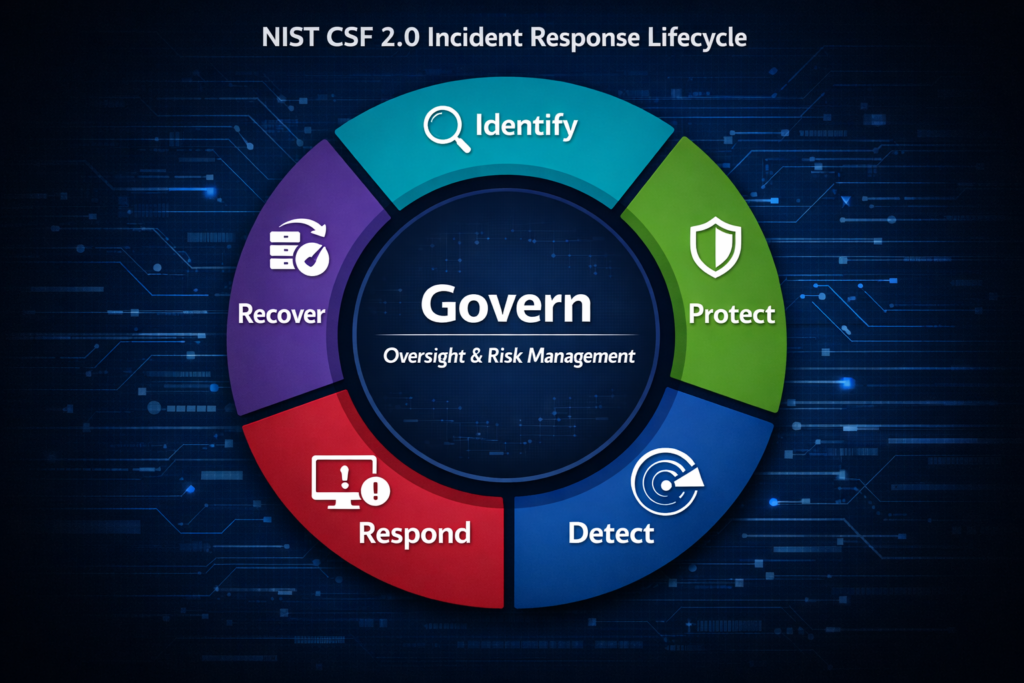
Circular NIST CSF 2.0 diagram with a dark‑navy “Govern” center and five equal outer segments labeled Identify, Protect, Detect, Respond, and Recover, each with its own color and icon on a cyber‑themed background.

The Evolution of Incident Response: Updating the Classic NIST IRP to the 2026 Framework

For years, cybersecurity teams followed the traditional NIST Incident Response Process: Preparation, Identification, Containment, Eradication, Recovery, and Lessons Learned. This model shaped how organisations built response capabilities and how students learned incident handling. The threat landscape has shifted dramatically, with cloud‑identity attacks defying linear phases, ransomware spreading before containment can begin, and supply‑chain compromises blurring

The Evolution of Incident Response: Updating the Classic NIST IRP to the 2026 Framework Read More »