
security operations

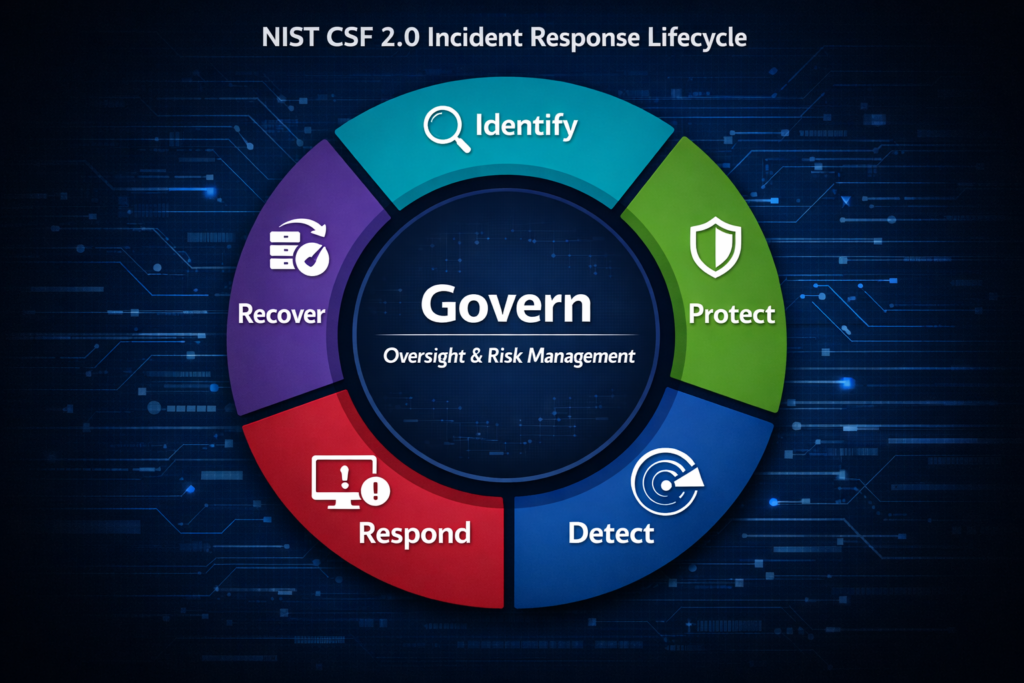
Circular NIST CSF 2.0 diagram with a dark‑navy “Govern” center and five equal outer segments labeled Identify, Protect, Detect, Respond, and Recover, each with its own color and icon on a cyber‑themed background.

Incident Response Series Round‑Up: IRP, PIR, Tabletop Exercises & NIST CSF 2.0

My interest in incident response started years ago during my first university course on the subject. It was the first time I’d seen how structured, disciplined, and genuinely powerful a well‑designed Incident Response Plan could be. That early exposure stayed with me. Later, when I began studying NIST CSF 2.0, I noticed something interesting: the […]

Incident Response Series Round‑Up: IRP, PIR, Tabletop Exercises & NIST CSF 2.0 Read More »
Circular NIST CSF 2.0 diagram with a dark‑navy “Govern” center and five equal outer segments labeled Identify, Protect, Detect, Respond, and Recover, each with its own color and icon on a cyber‑themed background.

How to Use Your IRP During an Incident (Aligned to NIST CSF 2.0)

My role as an analyst is managing incidents end‑to‑end, escalating when needed, and often acting as the point of coordination during active events. So I wanted to walk through how an Incident Response Plan is actually used during a live incident, the practical, real‑time steps that matter when you’re the one guiding the response. Most

How to Use Your IRP During an Incident (Aligned to NIST CSF 2.0) Read More »

Minimalist blue‑toned banner showing cybersecurity icons, a laptop with a shield, and the title “How to Write a Modern Incident Response Plan (IRP) Using NIST CSF 2.0.”

How to Write a Modern Incident Response Plan (IRP) Using NIST CSF 2.0

Most organisations have an IRP. Most discover it doesn’t work the moment they actually need it. Not because the document is wrong, but because it was written for the organisation they used to be, not the one responding to an incident today. Incidents in 2026 are cloud‑distributed, identity‑driven, SaaS‑entangled, and business‑impacting. Modern incident response is

How to Write a Modern Incident Response Plan (IRP) Using NIST CSF 2.0 Read More »

Circular NIST CSF 2.0 diagram with a dark‑navy “Govern” center and five equal outer segments labeled Identify, Protect, Detect, Respond, and Recover, each with its own color and icon on a cyber‑themed background.

The Evolution of Incident Response: Updating the Classic NIST IRP to the 2026 Framework

For years, cybersecurity teams followed the traditional NIST Incident Response Process: Preparation, Identification, Containment, Eradication, Recovery, and Lessons Learned. This model shaped how organisations built response capabilities and how students learned incident handling. The threat landscape has shifted dramatically, with cloud‑identity attacks defying linear phases, ransomware spreading before containment can begin, and supply‑chain compromises blurring

The Evolution of Incident Response: Updating the Classic NIST IRP to the 2026 Framework Read More »