
incident response

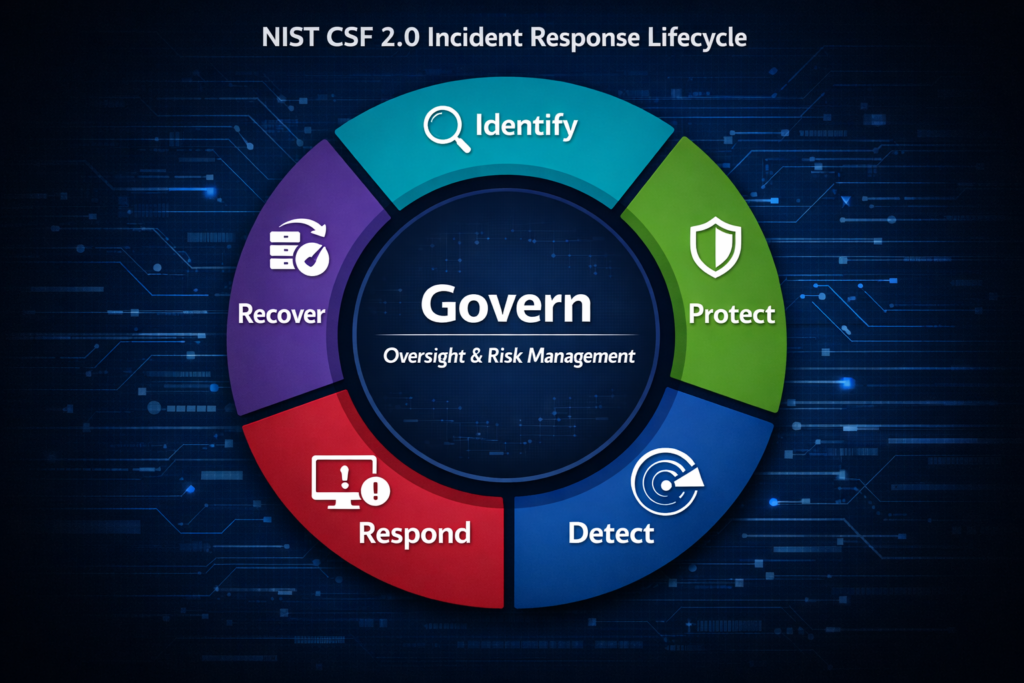
Circular NIST CSF 2.0 diagram with a dark‑navy “Govern” center and five equal outer segments labeled Identify, Protect, Detect, Respond, and Recover, each with its own color and icon on a cyber‑themed background.

Incident Response Series Round‑Up: IRP, PIR, Tabletop Exercises & NIST CSF 2.0

My interest in incident response started years ago during my first university course on the subject. It was the first time I’d seen how structured, disciplined, and genuinely powerful a well‑designed Incident Response Plan could be. That early exposure stayed with me. Later, when I began studying NIST CSF 2.0, I noticed something interesting: the […]

Incident Response Series Round‑Up: IRP, PIR, Tabletop Exercises & NIST CSF 2.0 Read More »

Circular NIST CSF 2.0 diagram with a dark‑navy “Govern” center and five equal outer segments labeled Identify, Protect, Detect, Respond, and Recover, each with its own color and icon on a cyber‑themed background.

How to Use Your IRP During an Incident (Aligned to NIST CSF 2.0)

My role as an analyst is managing incidents end‑to‑end, escalating when needed, and often acting as the point of coordination during active events. So I wanted to walk through how an Incident Response Plan is actually used during a live incident, the practical, real‑time steps that matter when you’re the one guiding the response. Most

How to Use Your IRP During an Incident (Aligned to NIST CSF 2.0) Read More »

A printed document titled “NIST CSF 2.0 Explained: Functions, Categories & Outcomes (Complete Mapping Guide)” lies on a modern corporate desk beside a MacBook Pro. The Tayven Cyber Security logo is stamped on the top page, and the document is neatly stapled in the top‑left corner, ready to be read.

The Complete Guide to NIST CSF 2.0 Mappings: Functions, Categories & Outcomes (And How to Use Them)

Series Introduction Every IRP, PIR, playbook, and tabletop in this series maps back to NIST CSF 2.0. If you want your security work to look mature, consistent, and defensible, you can’t just say “we follow NIST CSF 2.0.” You need to understand how Functions, Categories, and Outcomes actually fit together and how to use those

The Complete Guide to NIST CSF 2.0 Mappings: Functions, Categories & Outcomes (And How to Use Them) Read More »

A cybersecurity team sits around a conference table while a facilitator leads a tabletop exercise. The screen behind them displays the Tayven Cyber Security logo and the words “Tabletop Exercise: Cyber Security Team.”

How to Run a Cybersecurity Tabletop Exercise: A Complete Example Scenario and Facilitation Guide

Whenever I run a tabletop exercise, the first thing I do is set the tone for the room. I tell everyone that this is not a test and it’s not about catching anyone out. It’s a safe space to walk through our policies, procedures, and decision‑making as a team. The goal is to explore how we work, not judge how anyone performs.

How to Run a Cybersecurity Tabletop Exercise: A Complete Example Scenario and Facilitation Guide Read More »

A cybersecurity team sits around a conference table while a facilitator leads a tabletop exercise. The screen behind them displays the Tayven Cyber Security logo and the words “Tabletop Exercise: Cyber Security Team.”

How to Run a Cybersecurity Tabletop Exercise: Facilitator Script with Discussion Prompts

A good tabletop lives or dies on facilitation. A script doesn’t remove spontaneity, it creates psychological safety. It gives the facilitator a structure to fall back on, keeps the room aligned, and ensures the exercise stays focused on process rather than personalities. This script is written so that even a first‑time facilitator can run the scenario confidently while still leaving space for natural discussion and team dynamics.

How to Run a Cybersecurity Tabletop Exercise: Facilitator Script with Discussion Prompts Read More »

A cybersecurity team sits around a conference table while a facilitator leads a tabletop exercise. The screen behind them displays the Tayven Cyber Security logo and the words “Tabletop Exercise: Cyber Security Team.”

How to Write an After Action Report (AAR) for Cyber Tabletop Exercises

An After‑Action Report is where a tabletop exercise turns into something real. It’s the moment where the conversation becomes clarity, and clarity becomes improvement. This AAR captures not just what happened in the scenario, but how the team thought, reacted, hesitated, and learned, because that’s where the real value sits.

How to Write an After Action Report (AAR) for Cyber Tabletop Exercises Read More »

A cybersecurity team sits around a conference table while a facilitator leads a tabletop exercise. The screen behind them displays the Tayven Cyber Security logo and the words “Tabletop Exercise: Cyber Security Team.”

How to Create a Participant Handout for a Cybersecurity Tabletop Exercise

A participant handout sets the tone for the entire exercise. It gives everyone the same starting point, removes uncertainty, and helps people focus on the scenario rather than trying to remember process details. This one is designed to be read in under two minutes, just enough to orient the room without overwhelming it.

How to Create a Participant Handout for a Cybersecurity Tabletop Exercise Read More »

A printed Post‑Incident Review document with the Tayven Cyber Security logo resting on a laptop keyboard, showing a blue digital network map on the screen and a silver pen placed diagonally across the page.

How to Write a Post-Incident Review (PIR) Report (With Real-World Example)

A PIR isn’t just paperwork. It’s where the real learning happens. It’s the document that turns an incident into improvement. To show you what a mature, well‑structured PIR looks like in practice, here’s a full example based on a realistic MFA fatigue and OAuth compromise scenario.

How to Write a Post-Incident Review (PIR) Report (With Real-World Example) Read More »

Minimalist blue‑toned banner showing cybersecurity icons, a laptop with a shield, and the title “How to Write a Modern Incident Response Plan (IRP) Using NIST CSF 2.0.”

How to Write a Modern Incident Response Plan (IRP) Using NIST CSF 2.0

Most organisations have an IRP. Most discover it doesn’t work the moment they actually need it. Not because the document is wrong, but because it was written for the organisation they used to be, not the one responding to an incident today. Incidents in 2026 are cloud‑distributed, identity‑driven, SaaS‑entangled, and business‑impacting. Modern incident response is

How to Write a Modern Incident Response Plan (IRP) Using NIST CSF 2.0 Read More »

Circular NIST CSF 2.0 diagram with a dark‑navy “Govern” center and five equal outer segments labeled Identify, Protect, Detect, Respond, and Recover, each with its own color and icon on a cyber‑themed background.

The Evolution of Incident Response: Updating the Classic NIST IRP to the 2026 Framework

For years, cybersecurity teams followed the traditional NIST Incident Response Process: Preparation, Identification, Containment, Eradication, Recovery, and Lessons Learned. This model shaped how organisations built response capabilities and how students learned incident handling. The threat landscape has shifted dramatically, with cloud‑identity attacks defying linear phases, ransomware spreading before containment can begin, and supply‑chain compromises blurring

The Evolution of Incident Response: Updating the Classic NIST IRP to the 2026 Framework Read More »