Tayven

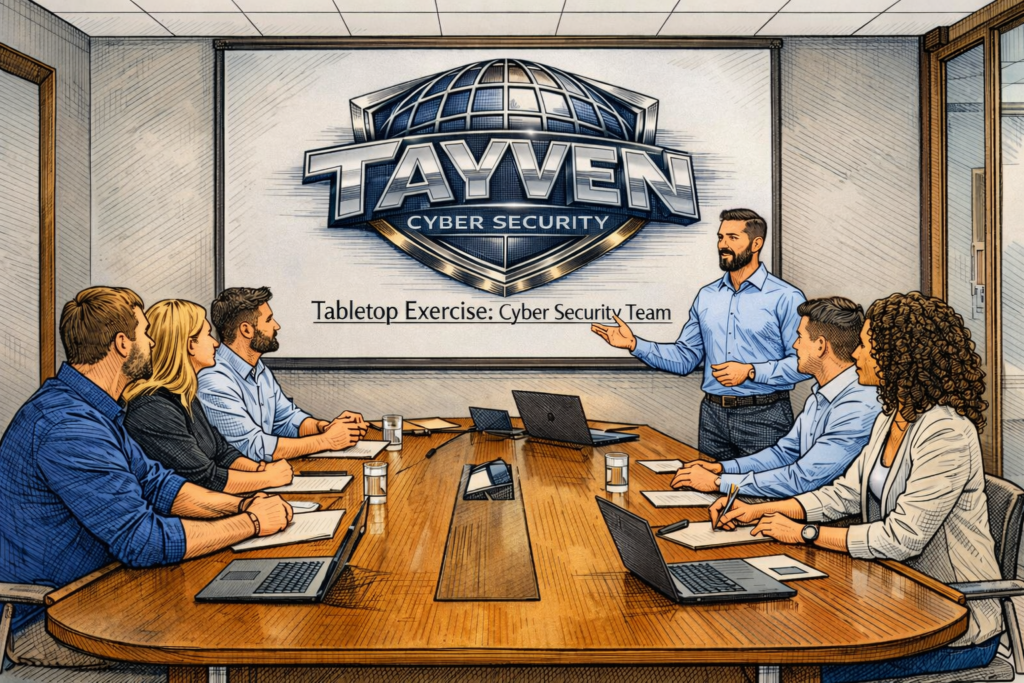
A cybersecurity team sits around a conference table while a facilitator leads a tabletop exercise. The screen behind them displays the Tayven Cyber Security logo and the words “Tabletop Exercise: Cyber Security Team.”

How to Run a Cybersecurity Tabletop Exercise: Facilitator Script with Discussion Prompts

A good tabletop lives or dies on facilitation. A script doesn’t remove spontaneity, it creates psychological safety. It gives the facilitator a structure to fall back on, keeps the room aligned, and ensures the exercise stays focused on process rather than personalities. This script is written so that even a first‑time facilitator can run the scenario confidently while still leaving space for natural discussion and team dynamics.

How to Run a Cybersecurity Tabletop Exercise: Facilitator Script with Discussion Prompts Read More »


A cybersecurity team sits around a conference table while a facilitator leads a tabletop exercise. The screen behind them displays the Tayven Cyber Security logo and the words “Tabletop Exercise: Cyber Security Team.”

How to Run a Cybersecurity Tabletop Exercise: A Complete Example Scenario and Facilitation Guide

Whenever I run a tabletop exercise, the first thing I do is set the tone for the room. I tell everyone that this is not a test and it’s not about catching anyone out. It’s a safe space to walk through our policies, procedures, and decision‑making as a team. The goal is to explore how we work, not judge how anyone performs.

How to Run a Cybersecurity Tabletop Exercise: A Complete Example Scenario and Facilitation Guide Read More »

A printed Post‑Incident Review document with the Tayven Cyber Security logo resting on a laptop keyboard, showing a blue digital network map on the screen and a silver pen placed diagonally across the page.

How to Write a Post-Incident Review (PIR) Report (With Real-World Example)

A PIR isn’t just paperwork. It’s where the real learning happens. It’s the document that turns an incident into improvement. To show you what a mature, well‑structured PIR looks like in practice, here’s a full example based on a realistic MFA fatigue and OAuth compromise scenario.

How to Write a Post-Incident Review (PIR) Report (With Real-World Example) Read More »

Tayven Tech logo featuring a chrome sphere with blue circuit patterns above bold text.

How to Remove Old Wi‑Fi Networks (and Why Your Devices Keep Reconnecting to Them)

Tayven Tech – Practical Device Tips Old Wi‑Fi networks cause all kinds of annoying problems: your phone auto‑joins a weak café hotspot, your laptop clings to a neighbour’s guest network, or your Mac keeps trying to connect to a router you replaced years ago. The fix is simple, remove the old networks. But to stop

How to Remove Old Wi‑Fi Networks (and Why Your Devices Keep Reconnecting to Them) Read More »

Futuristic comic-style cover showing a hooded figure walking into a glowing digital corridor beneath the Tayven Cyber Security logo.

How I Got Into Cyber, Got Uni for Free, and Passed the SC‑900

Tayven Cyber Security Edition #1: The Education Arc Inside: Uni for Free, Getting Into Cyber, Passing the SC‑900, and the HTB Web Exploitation Pathway You step into the digital frontier, not a void, but a living expanse of systems, signals, and unseen architecture. The paths ahead aren’t labeled; they shift and shimmer with possibility. Cloud,

How I Got Into Cyber, Got Uni for Free, and Passed the SC‑900 Read More »

Minimal, modern abstract background in Microsoft‑style gradients of blue, teal, and purple with geometric shapes and icons representing cloud, identity, and security. Title text reads “How I Passed the SC‑900 on My First Attempt (Using 4 Free Tools + 2 Paid)."

How I Passed the SC-900 on My First Attempt (Using 4 Free Tools + 2 Paid)

I’ve been working with Microsoft systems for years, but this year I finally decided to take the Microsoft certification pathway seriously. Everywhere I looked, job ads, cyber roles, cloud positions, Microsoft certifications were becoming a baseline expectation. They’re affordable, the learning material is free, and they map directly to real‑world work. It just made sense

How I Passed the SC-900 on My First Attempt (Using 4 Free Tools + 2 Paid) Read More »

Patch Management Series logo featuring a metallic shield with two interlocking gears and a digital circuit background.

June 2026 SECURITY PATCH ROUNDUP – Windows, iOS, macOS, Android, Linux

June’s Patch Tuesday delivers a heavy month across all major platforms, with critical kernel vulnerabilities, remote code execution risks, and multiple privilege‑escalation vectors affecting Windows, Apple, Android, and Ubuntu systems. This month’s updates include several container‑escape paths, Secure Boot certificate changes, and high‑impact vendor component fixes across mobile ecosystems. Below is the full breakdown for

June 2026 SECURITY PATCH ROUNDUP – Windows, iOS, macOS, Android, Linux Read More »

A cybersecurity-themed workspace featuring two monitors with data and security icons, a laptop, headphones, magnifying glass, and a blank notebook with a pen. The text overlay reads “How to Build an Incident Response Plan: A Complete CSF 2.0 Guide.”

How to Build an Incident Response Plan: A Complete NIST CSF 2.0 Example

This article isn’t just a guide, it’s a complete, modern Incident Response Plan aligned to NIST CSF 2.0. A full, real‑world IRP you can use as a reference, benchmark, or starting point for your own organisation.

How to Build an Incident Response Plan: A Complete NIST CSF 2.0 Example Read More »

Minimalist blue‑toned banner showing cybersecurity icons, a laptop with a shield, and the title “How to Write a Modern Incident Response Plan (IRP) Using NIST CSF 2.0.”

How to Write a Modern Incident Response Plan (IRP) Using NIST CSF 2.0

Most organisations have an IRP. Most discover it doesn’t work the moment they actually need it. Not because the document is wrong, but because it was written for the organisation they used to be, not the one responding to an incident today. Incidents in 2026 are cloud‑distributed, identity‑driven, SaaS‑entangled, and business‑impacting. Modern incident response is

How to Write a Modern Incident Response Plan (IRP) Using NIST CSF 2.0 Read More »

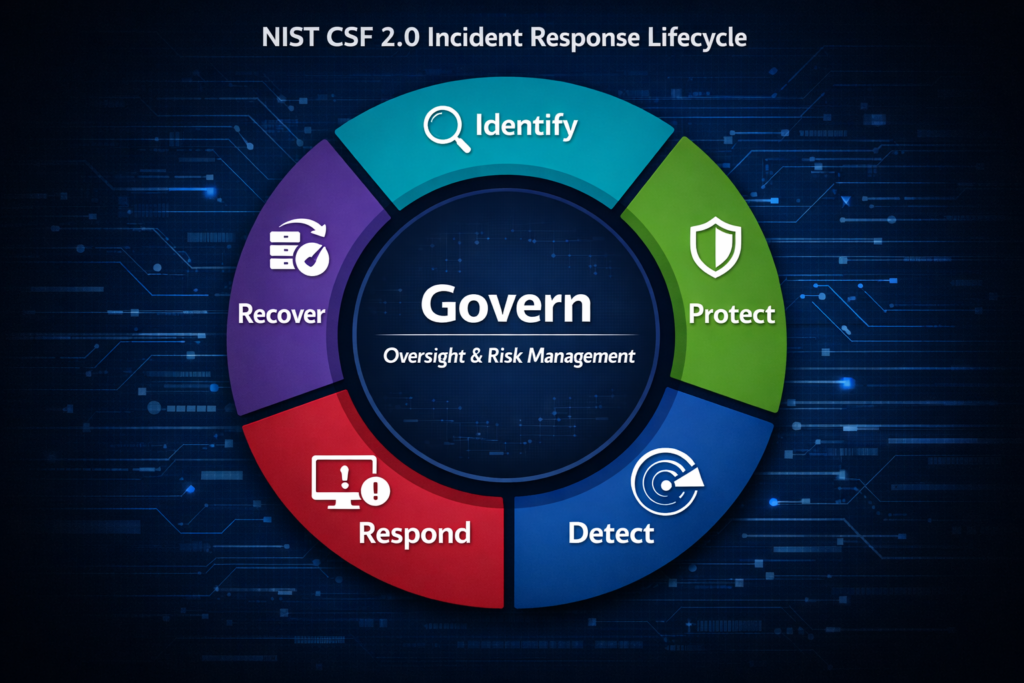
Circular NIST CSF 2.0 diagram with a dark‑navy “Govern” center and five equal outer segments labeled Identify, Protect, Detect, Respond, and Recover, each with its own color and icon on a cyber‑themed background.

The Evolution of Incident Response: Updating the Classic NIST IRP to the 2026 Framework

For years, cybersecurity teams followed the traditional NIST Incident Response Process: Preparation, Identification, Containment, Eradication, Recovery, and Lessons Learned. This model shaped how organisations built response capabilities and how students learned incident handling. The threat landscape has shifted dramatically, with cloud‑identity attacks defying linear phases, ransomware spreading before containment can begin, and supply‑chain compromises blurring

The Evolution of Incident Response: Updating the Classic NIST IRP to the 2026 Framework Read More »