For years, cybersecurity teams followed the traditional NIST Incident Response Process: Preparation, Identification, Containment, Eradication, Recovery, and Lessons Learned. This model shaped how organisations built response capabilities and how students learned incident handling.
The threat landscape has shifted dramatically, with cloud‑identity attacks defying linear phases, ransomware spreading before containment can begin, and supply‑chain compromises blurring the boundaries between preparation, detection, and response.
And organisations now require governance, resilience, and business alignment, not just technical reaction.
In 2025, the National Institute of Standards and Technology (NIST) released Special Publication 800‑61 Revision 3, formally retiring the classic lifecycle and replacing it with a modern, flexible, CSF‑aligned structure. This article updates the traditional IRP model to the newest NIST guidance and shows how each of the old phases maps into today’s incident response framework.
Further NIST CSF 2.0 reading to help you build your own IRP.
- How to Build an Incident Response Plan: A Complete NIST CSF 2.0 Example – a full, end‑to‑end example of a complete IRP aligned to NIST CSF 2.0.
- How to Write a Modern Incident Response Plan (IRP) Using NIST CSF 2.0 – a breakdown of each IRP section and how it maps directly to CSF 2.0 functions and categories.
Why the Old NIST IR Lifecycle Needed to Change
The traditional lifecycle was built for a world where incidents were mostly on‑premises, host‑based, and linear. Your original descriptions reflect this clearly:
The preparation phase is when the Incident Response team prepares for a Cyber Security Incident.
During the identification phase, a Cyber Security Analyst monitors alerts, events, and security incidents and assesses them…
The containment phase is when a Cyber Security Incident is declared, and the response team contains the incident.
This model worked well when incidents unfolded step‑by‑step.
But modern incidents are multi‑stage, identity‑driven, cloud‑distributed, supply‑chain‑dependent, business‑impacting, and continuous. A rigid loop cannot describe a world where detection, containment, communication, and recovery often happen simultaneously.
NIST recognised this and rebuilt the entire incident response framework.
Clarifying the “Classic” Incident Response Lifecycle
It’s worth noting that the six‑phase lifecycle often taught in cybersecurity courses, Preparation, Identification, Containment, Eradication, Recovery, and Lessons Learned is actually a widely used instructional adaptation rather than the official NIST model. In NIST SP 800‑61 Revision 2, the formal lifecycle consisted of four phases: Preparation, Detection & Analysis, Containment/Eradication/Recovery, and Post‑Incident Activity. Many training providers, including EC‑Council, CompTIA, and academic programs, break these out into six distinct stages to make the workflow easier to teach and understand. This article updates that commonly taught six‑phase model to the new 2025 NIST SP 800‑61r3 framework, which replaces both versions with a modern, CSF‑aligned structure.
Introducing the New NIST IRP Structure (SP 800‑61r3 + CSF 2.0)
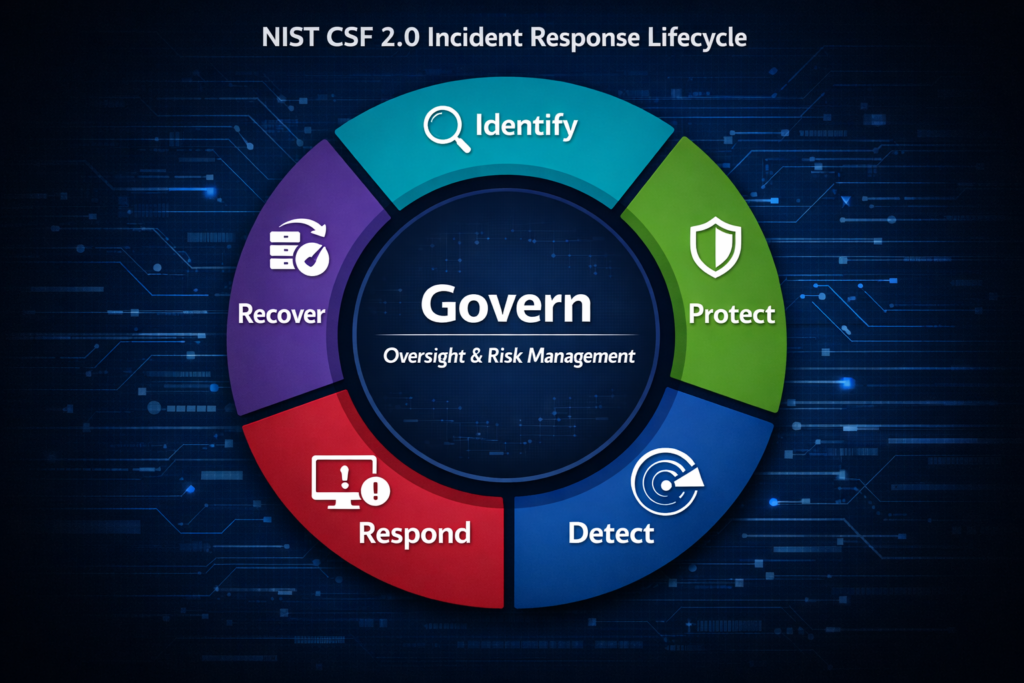
Instead of a standalone lifecycle, incident response is now integrated across the NIST Cybersecurity Framework (CSF) 2.0 functions:
- Govern
- Identify
- Protect
- Detect
- Respond
- Recover
This shift reflects how real incidents unfold in 2026.
The new model emphasises:
- Governance as a foundational requirement
- Continuous improvement, not a final step
- Business alignment, not just technical actions
- Flexible workflows, not rigid phases
- Resilience, not just response
Incident response is no longer a reaction, it is an organisational capability.
Mapping the Old NIST IRP to the New 2026 Framework
Here is how each phase translates into the modern model.
1. Preparation → Govern + Identify + Protect
My original description:
“Assemble an Incident Response Team. Gather corporate asset lists of critical networks and systems. Build procedures and make decisions.”
In the new model, these activities fall under:
- Govern: roles, oversight, communication, escalation
- Identify: asset lists, risks, diagrams
- Protect: hardening, tooling, readiness
Preparation is no longer a single phase, it is a continuous organisational responsibility.
2. Identification → Detect
My original description:
“During the identification phase, a Cyber Security Analyst monitors alerts, events, and security incidents and assesses them…”
This maps directly to Detect, which includes:
- monitoring
- logging
- alert triage
- threat intelligence
- anomaly detection
The work remains the same; the framing has evolved.
3. Containment + Eradication → Respond
My original descriptions:
“The containment phase is when a Cyber Security Incident is declared…”
“During the eradication phase, the Incident Response team works to remove the threat…”
These now sit under Respond, which covers:
- analysis
- containment
- eradication
- communication
- stakeholder coordination
Respond is broader and more flexible than the old phases.
4. Recovery → Recover
My original description:
“During the recovery phase, the Incident Response team works to rebuild the systems to a normal state.”
This aligns perfectly with Recover, which now emphasises:
- resilience
- restoration
- validation
- business continuity
- post‑incident hardening
Recovery is no longer “the end” — it is part of a continuous cycle.
5. Lessons Learned → Govern + Continuous Improvement
My original description:
“The team then writes an incident report… and reviews the Plan to assess what worked…”
This now maps to:
- Govern: oversight, reporting, accountability
- Continuous Improvement: embedded across the entire CSF
Lessons learned is no longer a final step, it is a governance function.
What This Shift Means for Modern IR Teams
The new model reflects a simple truth: Incident response is now an organisational capability, not a technical sequence.
This shift means:
- IR must be tied to business risk
- Governance is essential
- Communication is strategic
- Cloud and identity incidents require flexible workflows
- Continuous improvement is mandatory
- IR is part of resilience, not just security
For organisations, this means stronger alignment with business outcomes.
For practitioners, it means broader skills and cross‑team collaboration.
For students and new analysts, it means learning IR as a system, not a sequence.
Conclusion: Why Understanding Both Models Still Matters
The old lifecycle remains a useful teaching tool. It is simple, structured, and easy to understand.
But the new CSF‑aligned model is what organisations actually use in 2026.
Understanding both provides:
- historical context
- practical mapping skills
- a modern, risk‑aligned perspective
- the ability to explain IR to technical and non‑technical audiences
This article forms the foundation for a modern incident response series and a clear demonstration of how cybersecurity evolves alongside the threats it defends against.
Knowing the old model still matters. Knowing the new one is what your organisation actually needs. Over the coming weeks, this series will take the theory off the page, walking through a complete IRP build, a full example plan, and a real-world incident analysed through the 2026 framework. By the end, you won’t just understand incident response. You’ll know how to do it.
References
The NIST Cybersecurity Framework (CSF) 2.0 Documentation
Continue Reading
Check out my other articles! If you enjoyed this one, you’ll probably like the rest of my cyber stories, guides, and breakdowns too.