Tax season is when Australians are most vulnerable to scams, and scammers know it. Every year, thousands of people receive fake ATO and myGov messages designed to steal refunds, personal information, or access to accounts. If you work, lodge, or claim anything through myGov, these scams are aimed directly at you.
I write a lot about everyday cyber security, and ATO impersonation scams are one of the most common real‑world threats people bring to me. The good news? Once you know the red flags, these scams become much easier to spot.
This guide breaks down the most common ATO tax scams, how they work, and what to do if you receive one, based on current alerts from Scamwatch and the Australian Taxation Office.
Why ATO Tax Scams Surge During Tax Time
Scammers target Australians during tax season because:
- people expect refunds
- people respond quickly to myGov notifications
- people are anxious about debts or compliance
- people are dealing with tax agents and documents
The ATO reported 7,500 impersonation scam attempts in July last year (ATO Scam Alerts, 2025), and Scamwatch warns this number spikes every EOFY.
The 5 Most Common ATO Tax Scams Right Now
1. Fake Tax Debt or Threat Messages
These are the most aggressive scams. They claim you owe money or your TFN has been suspended.
Examples:
- “You have an outstanding tax debt. Pay immediately.”
- “Your TFN has been suspended due to illegal activity.”
- “A warrant will be issued for your arrest unless you pay.”
Why it works: Fear + urgency. Scammers want you to panic.
Reality: The ATO never threatens arrest, prosecution, or TFN cancellation via SMS or email.
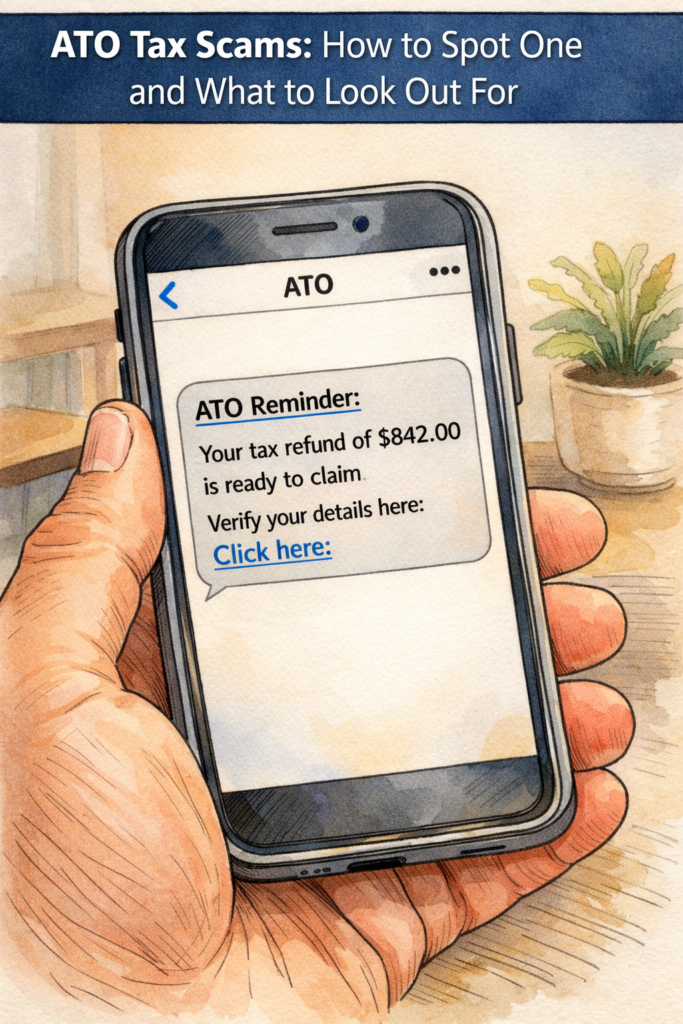
2. Fake ATO Refund Messages
These promise a refund and push you to a fake login page.
Examples:
- “You are due to receive an ATO Direct refund.”
- “Your tax refund has failed, update your details.”
Why it works: People expect refunds during tax season.
Reality: The ATO never sends links in SMS or email to access refunds or myGov.
3. Fake myGov Login Pages
These are extremely common. Scamwatch reports that three‑quarters of ATO impersonation emails link to fake myGov sign‑in pages (Scamwatch Quarterly Report, 2025).
How it works: You click the link → it opens a perfect clone of the myGov login page → scammers capture your credentials.
What scammers do next:
- steal your tax refund
- change your bank details
- lodge fraudulent returns
- access your superannuation
4. DocuSign or “Urgent Document” Scams
These appear as legitimate DocuSign emails but redirect to fake myGov pages.
Example:
- “You have an outstanding tax-related DocuSign that requires action.”
Reality: The ATO does not use DocuSign for tax returns, refunds, or compliance notices.
5. Cryptocurrency or “Asset Declaration” Scams
A newer scam claims you hold cryptocurrency in a “non‑KYC wallet” and must declare it immediately.
Reality: The ATO will never email you demanding immediate disclosure of cryptocurrency or threaten legal action via email or SMS.
The 30‑Second ATO Scam Checklist
If you only remember one section, make it this one.
ATO messages are fake if they:
- contain a link
- ask for personal information
- use urgent or threatening language
- come from a non‑gov.au email
- request payment via gift cards, crypto, or unusual methods
If any of these appear → it’s a scam.
How to Verify an ATO Message
Follow the Scamwatch model:
STOP
Pause first. Don’t click. Don’t respond.
End the call, delete the message, and remove the pressure. Scammers win when you act automatically, breaking that reflex protects you.
CHECK
Verify using official channels:
- the official myGov app
- The Official myGov website – https://my.gov.au/
- the official ATO app
- The Official ATO website – https://www.ato.gov.au/
- 1800 008 540 (ATO scam verification line)
- Review ATO Scam examples here https://www.ato.gov.au/online-services/scams-cyber-safety-and-identity-protection/scam-alerts
PROTECT
If you shared information:
- call your bank
- call the ATO
- contact IDCARE
- contact NSW ID Support
- report to ReportCyber
What To Do If You Already Clicked
If you’ve already clicked or responded, don’t panic, fast action makes a real difference.
1. Contact your bank immediately
They can block transactions and monitor for fraud.
2. Call the ATO on 1800 008 540
They can secure your account and prevent further misuse.
3. Report the scam
- ReportCyber (if money or data was stolen)
- Scamwatch (if you received but didn’t fall for it)
4. Contact IDCARE
If you’ve shared personal information, logged into a fake myGov page, or think your identity may have been compromised, contact IDCARE. They’re Australia’s national identity and cyber support service, and they work directly with you to assess the impact, secure your accounts, and create a personalised recovery plan. IDCARE can help you understand what information may have been exposed, what risks you face, and what steps to take next to protect yourself.
4. Contact NSW ID Support
If you ever receive a message like this or suspect your identity has been compromised, don’t try to handle it alone. In NSW, you can contact ID Support NSW, a dedicated government service that helps people recover from scams, secure their accounts, and protect their identity.
They provide practical, step‑by‑step support: https://www.nsw.gov.au/departments-and-agencies/id-support-nsw
My Rule
My rule is simple: I never click any link that arrives without me prompting it first. Out‑of‑the‑blue messages are a red flag, full stop. If something does come through, I won’t use the link, the email address, or the phone number inside that message. I go straight to the official app or website and check everything manually. If it’s not in the official app, then it wasn’t from the government. That one habit has protected me more times than I can count.
Final Thoughts
ATO tax scams are becoming more convincing, but the red flags haven’t changed. If a message:
- contains a link,
- asks for personal information,
- threatens you,
- or demands urgent action…
…it’s almost certainly a scam.
During tax season, the safest rule is simple:
Never click. Always verify. Always log in manually.
Cyber security isn’t about being perfect, it’s about being prepared. And once you know what these scams look like, they lose most of their power.
References
- ATO Scam Alerts
https://www.ato.gov.au/general/online-services/online-security/scam-alerts - Scamwatch (ACCC) – News & Alerts
https://www.scamwatch.gov.au/news-alerts - Scamwatch Quarterly Reports
https://www.scamwatch.gov.au/about-scamwatch/scamwatch-reports - IDCARE – Identity Support Service
https://www.idcare.org - ReportCyber – Australian Government
https://www.cyber.gov.au/report - NSW Government – ID Support
https://www.nsw.gov.au/departments-and-agencies/id-support-nsw
Further Reading: Cyber Security Awareness Series
If this incident taught me anything, it’s that cyber security isn’t about being perfect, it’s about being prepared.
- “Hi Dad, I Dropped My Phone”: How a Simple Text Stole $3600 And Why This Scam Is Exploding – A complete breakdown of the “Hi Dad / Hi Mum” text message scams
- The Toll Scam Text Message That Hit Me Inside the Tunnel– A practical guide to recognising and avoiding toll‑text message scams.
- Social Media Privacy Reset – A step-by-step guide to tightening your social media privacy settings.
- Think Before You Click – How to recognise suspicious links, messages, and online traps before you fall for them.
- Strong Authentication Made Simple – A clear breakdown of MFA, why it matters, and how to set it up properly.
- Everyday Device Protection – Simple settings and habits that harden your phone and laptop against common threats.
- Travel Cyber Security Tips – How to stay secure on public Wi-Fi, in airports, hotels, and while exploring abroad.
- Introducing Everyday Cyber Security – The origin of the series and the philosophy behind making cyber security accessible.